Precarity and Redeployment
Understanding postdoc role preferences
Early research careers are often characterised by a lack of employment security and narrow career paths (OECD, 2021). Several research organisations have suggested problems associated with precarity could be mitigated by redeploying researchers between posts within the organization (Russell Group, 2021; UCU, 2023; UKRI, 2023), which might involve sacrificing academic freedom and other factors in favour of increased job security. We are examining whether redeployment is an appealing and feasible approach to mitigating precarity through three different angles.
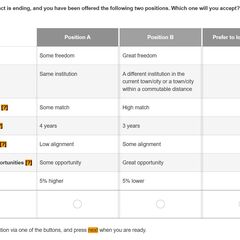
Firstly, we are conducting a Discrete Choice Experiment (DCE) to understand how postdocs trade-off between different factors when making career decisions, to understand for whom redeployment could be an appealing option. Our exploratory study, collated information from a systematic literature review, interviews and focus groups with postdocs and research career experts, and a large survey to compile a list of seven attributes that Early Career Researchers (ECR) care most about when making career decisions. These were piloted to generate a DCE design, which is being disseminated across ECRs in the UK.
Secondly, we want to understand various approaches to redeployment and their strengths and weaknesses. We are surveying redeployment policies across UK universities and interviewing PIs to understand their recruitment practices and experiences with redeployment.
Thirdly, we are using large language models (LLMs) and natural language processing techniques to analyse job adverts within the University of Cambridge and assess their degree of overlap in essential skills between them as listed in their Further Particular documents, as a proxy for redeployment feasibility. The results from this analysis should will tell us whether and for which disciplines redeployment is logistically feasible.
Comparing (the experience of precarity) between sectors
Literature indicates that one-third of university researchers in the UK have been employed on temporary contracts for over 10 years. It also shows that for many researchers, being on fixed-term contracts has become the norm/has become a long-term condition (Menard & Shinton, 2022). The feelings of precarity which come with this are one of the main challenges of working within academic research, and are linked challenges around health and wellbeing, financial stability, and independence. Precarity within academic research careers is a contributing factor to significant surges in academics moving from academia to the industry, and this trend is increasing.
This research study aims to understand if these feelings of precarity related to fixed term research contracts are found within academic institutions and within industry and how Early Career Researchers (ECRs) feel that contract precarity affects their wellbeing and productivity.
Understanding this has important implications for the sector and may identify opportunities to reduce the negative impact of the contract precarity ECRs face.
Example of Discrete Choice Experiment (DCE) structure